Does German wine really prefer colder growing seasons as optimal wine weather?
That was one of the first strange conclusions I got from my early WeinWetterWelt analysis. When I looked at German wine as one big group, the model seemed to suggest that better vintages were linked to colder temperatures during the growing season between April and September.
At first, this surprised me.
The classic story of weather-based wine prediction, especially inspired by Orley Ashenfelter, usually points in another direction: warmer growing seasons can be associated with better wine outcomes, at least this seems to be the case in famous wine region of Bordeaux in France. So when my first model suggested that German wine might prefer cooler growing seasons, I had two possible interpretations.
Either German wine is simply different.
Or my analysis was hiding something.
As it turns out, German wine is special but and truely does prefere colder temperatures overall, but there is an important catch.
The Problem Was Not the Wine Weather. It Was the Aggregation.
In the first version of the analysis, I treated German wine mostly as one combined category. Red wine, white wine, different regions, different wine styles — all of that was pushed into one large group.
That is sometimes useful. Aggregation can make data easier to summarize. It can reduce noise. It can help you see broad patterns.
But aggregation can also be dangerous.
Because when you combine groups that behave differently, the average pattern can become misleading. The model may show you something that looks like a real general rule, even though it is actually a mixture of several different processes.
In my case, the problem was simple:
German wine is strongly dominated by white wine.
And white wine does not necessarily respond to weather in the same way as red wine.
So when I looked at “German wine” as one category, I was mostly looking at a white-wine-dominated signal. The result looked like a general statement about German wine, but it was really much closer to a statement about German white wine.
That is an important difference.
Red and White Wine Do Not Tell the Same Weather Story
In the second version of WeinWetterWelt, I separated the analysis by wine type. Instead of asking only:
What weather is good for German wine?
I asked a better question:
What weather is good for German red wine, and what weather is good for German white wine?
That changed the interpretation.
For German white wine, the model still suggests that cooler growing seasons can be associated with higher predicted ratings. This makes intuitive sense. Many German white wines, especially Riesling-dominated styles, depend on freshness, acidity, and aromatic balance. Too much warmth can work against exactly that: as grapes ripen, sugar increases while acidity decreases, and higher temperatures can speed up the breakdown of malic acid. In simple terms, warmer conditions can make grapes sweeter but less acidic, which can make white wines taste less fresh. A recent Frontiers in Plant Science study discusses how climate change affects grape acidity and pH, and how scientists are testing grape varieties that may be better adapted to warmer conditions.
For German red wine the pattern looks different. The predicted ratings increase with warmer growing season temperatures. That also makes intuitive sense. Red grapes often need more warmth to ripen properly, develop structure, and avoid green or underripe characteristics.
So the first result was not completely wrong.
It was just incomplete.
And incomplete results are sometimes more dangerous than obviously wrong results, because they look reasonable enough to believe.
What the Plot Shows
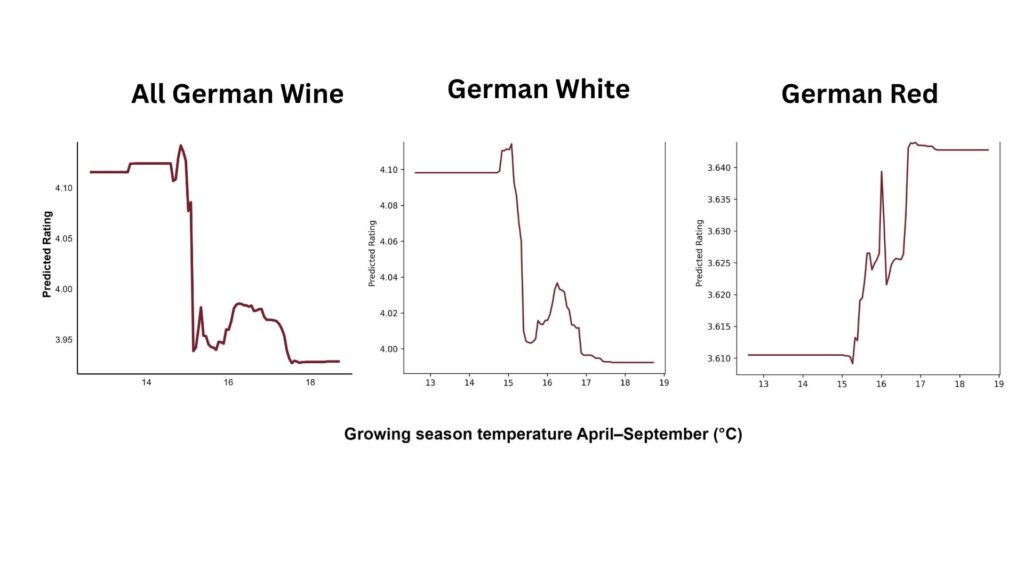
The image in this post shows three model responses for growing season temperature from April to September.
On the left, you see the aggregated result for all German wine. This is the version that originally made it look as if German wine generally prefers colder temperatures.
In the middle, you see German white wine. Here, the pattern looks similar.
On the right, you see German red wine. Here, the pattern reverses: warmer growing season temperatures are linked to higher predicted ratings.
This is exactly why separating red and white wine matters.
If you only look at the combined result, you might walk away with the idea that “German wine likes cold weather.”
But after separating wine types, the better interpretation is:
German white wine and German red wine can respond differently to growing season temperature.
That is much more useful.
It is also much less catchy, which is probably why data analysis is often less popular than simple slogans.
A Small Example of a Big Data Problem
This is not only a wine story.
It is a data analysis story.
One of the easiest mistakes in data analysis is to believe that a pattern in aggregated data automatically describes all groups inside the data. But that is not always true.
Sometimes the overall pattern is dominated by the largest group. Sometimes two groups show opposite trends. Sometimes the average hides the most important part of the story.
That is why data analysis should not stop after the first plot or the first model result.
A good result should survive basic questions:
- What groups are hidden inside the data?
- Are different categories being mixed together?
- Does the pattern still hold if I split the data?
- Is the result driven by one dominant subgroup?
- Does the interpretation make biological or practical sense?
For WeinWetterWelt, this meant that I had to stop treating all wine as if it reacted to weather in the same way.
Wine is not one thing. Red wine and white wine are made from different grapes, with different goals, different ripening needs, and different quality expectations.
The model should respect that.
Why This Matters for WeinWetterWelt
This is one of the reasons why WeinWetterWelt now separates wine by type.
The goal is not just to produce a score. The goal is to produce a score that makes sense.
A weather score for wine should not only be mathematically calculated. It should also be interpretable. If the model says something surprising, that can be useful — but only if we check whether the surprise comes from reality or from a mistake in the way we grouped the data.
In this case, the first analysis taught me something important:
If I aggregate too much, I can get a result that sounds like a general rule, but actually describes only part of the data.
That is why the newer version of WeinWetterWelt treats red and white wines separately.
It makes the tool more useful, and it makes the interpretation more honest.
The Lesson: Be Careful With Clean-Looking Results
The annoying thing about data aggregation is that it often creates results that look clean.
A single line is easy to explain.
A single conclusion is easy to remember.
“German wine likes colder weather” sounds simple.
But the better answer is:
German white wine may benefit from cooler growing seasons, while German red wine appears to benefit from warmer ones.
That sentence is less elegant, but probably closer to the truth.
And that is usually the trade-off in data analysis. The more honest explanation is often slightly messier.
But messy is not bad. Messy can mean that you are finally seeing the structure of the data instead of forcing everything into one simple story.
Try It Yourself
You can explore the difference between red and white wine directly on WeinWetterWelt.
Select Germany, choose red or white wine, pick a region and vintage, and compare how the weather score changes between wine types.
The next time you see a simple data conclusion, it may be worth asking:
What exactly was aggregated before this conclusion appeared?
Because sometimes the most important result is not the answer itself.
Sometimes it is realizing that the first answer was hiding a better question.